June 2005 "Ireland, unfree, shall never be at peace." - Padraig Pearse Issue 3
Noraid 2005 AGM meets in Philadelphia
Philadelphia was the site of this year's Irish Northern Aid AGM, and Noraid president and host Paul Doris welcomed delegates to his town with an event that truly reflected Philly's reputation as the city of brotherly love and sparked renewed enthusiasm among INA representatives from across the country.
It may be meaningful that this year, the 100th anniversary of Sinn Fein, the AGM was held in the city that gave birth to the greatest revolution for freedom and the greatest champion of liberty the world has ever known. Just down the street from where INA representatives discussed continued British institutionalized religious persecution in Ireland stood countless memorials to the religious freedom established in America by William Penn. Just down the street from where INA representatives discussed the continued British occupation of Ireland and the persecution of its people stood the park in which the American Declaration of Independence, responsive to much lesser infringements of rights, was read to a cheering crowd of American colonists - resulting in the tearing down and burning of British flags and emblems throughout the city. And just down from where INA representatives discussed their continuing hopes and efforts for a free and united Ireland stood the building in which the Constitution of the United States of America, the document most widely regarded as the greatest document of freedom and human rights in the world, was written.
It was in this environment, in a granite-walled hall of a building appropriately named The Phoenix - after the mythical bird that rises from its own ashes, and is the symbol of another group dedicated to Irish freedom - that Irish Northern Aid renewed its commitment to the reunification of a free Ireland and set its course for the coming year.
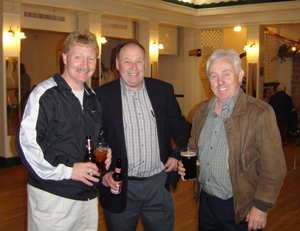
The weekend began Friday evening with buses transporting INA members from the hotel to the Commodore Barry Club, also known as the Irish Center, for a social time of food, drinks and Irish music. The club, named for the first secretary of the U.S. Navy John Barry, was established in the 1950s, and has the feel of the well established social center it is. INA members mingled among the locals who were there for a drink, a card game or to listen to the music session, and it was the perfect time for Noraid reps to meet each other, talk and relax before the real business of the weekend began. Old friends and new acquaintances talked of all things Irish, catching up with each other for the past year and discussing the latest developments in Ireland. A fire blazed in the center's common room, and musicians trickled in until a good sized group of tin whistles, flutes and fiddles assembled to fill the room with Irish music.
Saturday brought the meat of the weekend. In the impressive granite walled hall of the Phoenix in downtown Philadelphia, INA national Chairman Paul Doris, joined by Gerry Coleman, Mary Lou Powner, Rich Lawlor and others, layed out the direction Noraid needs to go in the coming year in order to best support the work being done by Sinn Fein and others in their continuing efforts to bring about the re-unification of a free Ireland.
Excerpts from Mr. Doris' address:
"The ceasefire has been in effect for 10 years," said Doris. "In Ireland, political strength is the way of the future, although nothing is ever certain in this life. As an extended arm of the movement we must change also, and we have been doing that - maybe too fast for some and too slow for others - but it must be done if we are to remain relevant.
"While the ceasefire and events have changed the dynamics in Ireland, September 11th has changed the world, and especially America, forever. We can't bury ourselves in the sand and say it has nothing to do with us, for it has, and it will affect all of us.
"So understanding that times have changed we must map a course to achieve our aims and goals, and to be successful we need a strong organization. Our units are our strength. We need locals doing local work, reaching out to the community, reaching out to local politicians, reaching out to those who have recently discovered their Irishness. Ask them to join your unit. Ask them to become involved at some level. The old days of winking and nodding in basements and cellars are over. We are an open organization that wants a free and united Ireland. We are proud of that fact and we should welcome everyone on board who subscribes to the notion.
"Ireland has as much right to democracy and freedom as Iraq, Georgia or Afghanistan, but it will remain behind the door without political punch or widespread support. Democracy and Freedom are the buzz words of today and we must remind people that Ireland has suffered more from the occupier than all those countries put together - and the time has come for the British to move on.
"INA has always lead the way among Irish organizations on political action here in the US. As a matter of fact, until very recently, most other organizations - and indeed some even to this day - have turned their backs on Irish Unity and the injustices occurring in Ireland. But hopefully, with our encouragement, they will all play their part in it in the future. It is never too late to join the struggle, and we should not feel threatened by latecomers. For example, we have lead successful campaigns for the McBride Principles, Hunger Strikers, deportee cases and visa denial. We know how it's done and will continue to do it for future campaigns.
"One principle we always had was not to get too involved in individual cases. We always had the bigger picture in mind. I always remind myself we are working for the people of Ireland, not the person from Ireland, and I have even gotten into arguments over this with my own relatives - one who's son was killed and another who's son was wounded by the SAS.
"It was us in INA who encouraged the deportees to form together and campaign together, which resulted in a good outcome. I know we have individuals now who have been extradited or are facing extradition, and each one is indeed a sad case, but there are many others out there that have not come public yet and they deserve as much of our attention as anyone else.
"As I said, all are sad cases in their own right and we will help them as much as we can. We did give the McAllister committee the use of our office and the use of our 1-800 number when they needed it. We gave artwork to the Verry committee, and as individuals we have worked with those and other committees.
"I would be remiss if I did not mention John McNicoll who lived in Philadelphia for many years. Now, you talk about an injustice and a sad case. By John being extradited, the government in fact extradited his whole family, including his teenage kids who were born here - American citizens who never lived anywhere else.
"As I say, we will work with all extradition committees - but not at the expense of the broader picture. Nothing pleases our enemies more than for us to be fragmented and diverted from our main objective.
"My friends, we are knocking on freedom's door. We have come a long way. You have lead the way - and I know you will continue to lead the way until freedom's door is unlocked forever."
The guest speaker at the AGM was Bernice Swift, the newly elected Sinn Fein councilor from County Fermanagh, who discussed the importance of the British government addressing the issue of collusion between security forces and loyalist paramilitaries in the 6 counties as an important step in rejoining the peace process.
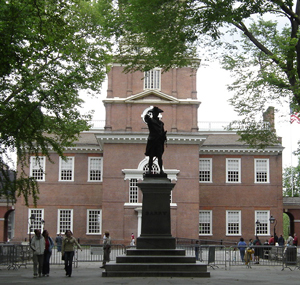
The Statue of John Barry is silhouetted against Independence Hall. Barry, the first secretary of the U.S. Navy, was born in Wexford, Ireland.
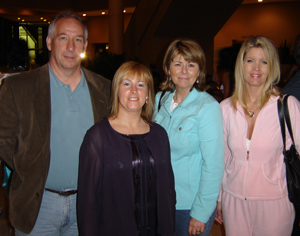
Roy McCann and Mick Byrne of the San Diego unit with National Chairman Paul Doris.
Jim & Marsha Callahan and Kelly Smith of the Kansas City Unit with Sinn Fein representative Bernice Swift.
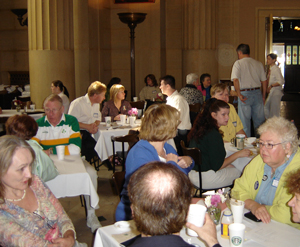
Saturday began with breakfast at the Phoenix.
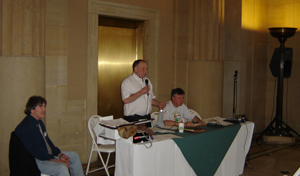
Paul Doris addresses the AGM.
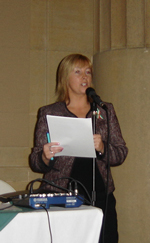
Bernice Swift
"Sinn Fein is ready to do business."
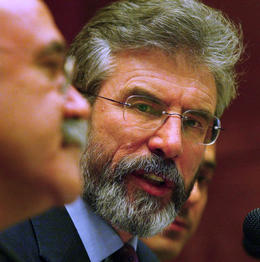
Talk to us", says Adams
Ian Paisley's DUP has been challenged to
formally enter dialogue with republicans for
the first time. Sinn Fein president Gerry Adams
said the DUP's current position of not negotiating
with Sinn Fein was not sustainable, although
he recognised the hardline unionists might
find the prospect "difficult" and "uninviting". Mr Adams said he awaited a positive response from the IRA to his appeal for them to declare a purely non-violent democratic future - and said there was now an unprecedented opportunity to make political progress in the North of Ireland.
In a direct message to the DUP, he said their recent electoral successes had given them the leadership of unionism and they could not opt out of their responsibilities. "Their increased mandate brings with it increased responsibility and an imperative to deliver for their electorate. The DUP needs to engage in a meaningful way in the political process and that means engaging, negotiating and talking with Sinn Fein," said Mr Adams. He conceded: "The DUP may find that is a very uninviting prospect," adding: "We can all find excuses not to engage."
Mr Adams said in a statement that Sinn Fein recognised and respected the DUP's mandate and knew that a necessary element of any conflict-resolution process was inclusive, unconditional dialogue. That demanded a serious effort in good faith to engage with political opponents, he said.
"Dialogue with political opponents may be difficult, as much for Sinn Fein as for the DUP, but dialogue is the only way forward, the only way to build a lasting peace. The public position of the DUP is unsustainable. At some point, the DUP will have to enter the world of real politics. How else do they hope to deliver for their electorate?"
If the DUP did not want a return to the political institutions of the Good Friday Agreement, that was its choice and the party could refuse to take part, he said. However, the unionists could not stop the process of change - they could only "play for time and slow it down".
Asking if that was what unionism was reduced to, Mr Adams said the unprecedented opportunity to make progress required confidence, courage and leadership. That was the challenge facing the DUP, he said.
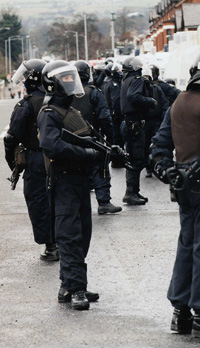
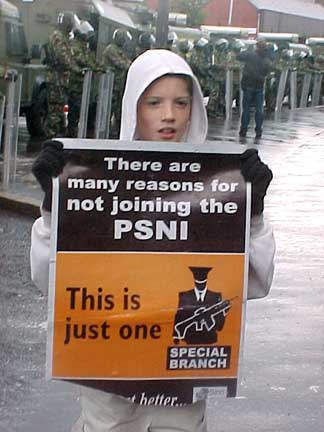
PSNI attacks protesters
North Antrim Sinn Féin MLA Philip
McGuigan has accused the PSNI of “behav-
ing in typical sectarian fashion” after PSNI
riot squads attacked nationalists protesting
against a loyalist parade through a mainly
nationalist part of Ballymena Saturday night,
4 June.
The Sinn Féin politician, who was himself
verbally abused and kicked by the PSNI, says
he intends to complain to the Police Ombuds-
man's office about the PSNI actions which he
described as “reminiscent of the scenes at
Burntollet during the early civil rights
campaign”, when RUC and Paisleyite
gangs set upon nationalist marchers.
Speaking to An Phoblacht, McGuigan said that nationalist residents had gathered near Market Road as the ‘Pride of the Maine’ loyalist band from Ballymena held its 30th anniversary band parade. McGuigan said everything was calm until PSNI members in armoured Land Rovers blocked roads running alongside All Saints Catholic Church and began attacking nationalist residents with batons as bandsmen emerged onto Market Street. “The PSNI started to push and haul at a number of residents and when I and a number of colleagues tried to intervene, a PSNI member ran out of the crowd and kicked me and told me to ‘F*ck Off you Fenian bastard’.”
Up to six residents were injured in the unprovoked attack by the PSNI, with one man needing hospital treatment after his head was split open by a baton. The man was later arrested and charged with disorderly behaviour. Another man was bitten by a PSNI dog.
“This was a violent, provocative, intimidating and sectarian series of attacks against nationalist bystanders. It is obvious that nationalists in Ballymena are still fighting a campaign for their civil rights. The PSNI operation was an absolute disgrace and in my opinion they acted in a sectarian manner in an attempt to provoke trouble,” said McGuigan.
The North Antrim politician told An Phoblacht that senior members of both the UVF and UDA had been filming nationalist residents during the triumphalist march. “This is a very worrying development for nationalists in this area. Senior loyalist paramilitaries were able to record the faces of local residents unhindered by the PSNI,” he said.
McGuigan has called for urgent meetings with both the Police Ombudsman and the Parades Commission. “I will be asking the Ombudsman to investigate what I can only describe as the sectarian brutality of the PSNI against nationalist residents on Saturday night and I am also going to ask the Parades Commission observers who witnessed the assaults for their reports.”
PSNI accused over
hit and run death
The family of a West
Belfast man killed when a
PSNI Land Rover hit him on
the Springfield Road are
questioning the PSNI’s ver-
sion of events.
Jim McMenamin (29) was
struck and killed by the PSNI
vehicle as he crossed the road
outside Gort na Mona GAC at around 1am on Saturday 4 June. It is understood McMenamin was crossing the road and was standing on the white diagonal markings when the PSNI vehicle hit him.
In their version of the accident, the PSNI claimed the patrol stopped and administered first aid at the scene, however this is disputed by local residents. People at the scene claimed that McMenamin died instantly and that the PSNI left the scene within minutes.
Colm McMenamin, the dead man’s brother, said: “The PSNI claimed to have given Jim first aid at the scene but he was killed outright. The PSNI who were in the Land Rover left the scene straight away and were taken to New Barnsley PSNI Barracks. It was there that the driver of the Land Rover was breathalised and not at the scene, as is the usual practice. If it had been a joy-rider who hit my brother, it would have been another crime if they then drove on for leaving the scene of a crime. Those four men were able to leave the scene within five minutes.”
McMenamin also pointed out that the length of the skid marks on the road suggest that the PSNI vehicle was traveling at more than the speed limit of 30mph at the time it hit his brother.
“I saw the damage to the front of the Land Rover; if you had hit a cow at 30 miles an hour it wouldn’t have caused as much damage. The front of those vehicles are really solid, especially where the grille is and yet there were dents on the grille and bonnet”.
Sinn Féin President Gerry Adams says many serious questions need to be answered about the circumstances surrounding the killing of Jim McMenamin and the role of the PSNI and its behavior immediately after the incident. “There is serious disquiet in the local community, shared by the family, that the PSNI handling of Saturday’s incident gives real concern,” he said. “The family want no cover up — they want the truth.”
Adams called on anyone who may have witnessed the incident to contact the Police Ombudsman’s office, which is investigating. “I am appealing to anyone who saw anything or who has any information to bring that forward to the Police Ombudsman. It is important that this is done in conjunction with a solicitor,” concluded Adams.
Water cannon used by police in north Belfast during trouble at an Orange Order parade.
Stones and golf balls were thrown at marchers taking part in the return leg of the Tour of the North parade as they passed a flashpoint area at Ardoyne. Marchers were attacked from the nationalist end, and there have been a number of injuries.
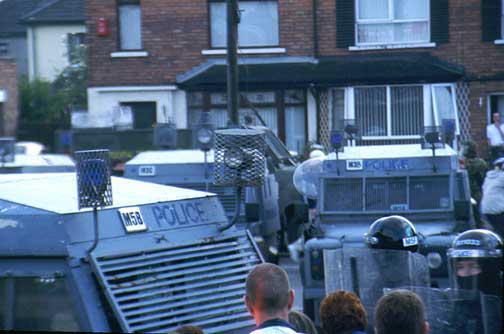
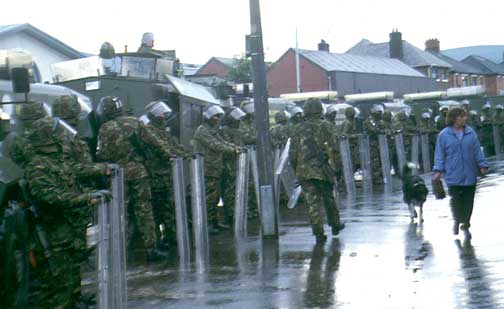
Earlier, police said they had put in place a significant security operation, but hoped the march would be peaceful. However, trouble flared at about 2100 BST as three lodges, followed by supporters, went past Ardoyne shops where nationalists had gathered to protest the march. Marchers had been separated from the protesters by a corridor of about 60 Land Rovers and police in riot gear, but were still pelted with missiles, including bottles and bricks. There were further clashes between police and protesters and the water cannon were deployed.
Police have now pulled out towards the junction of the Crumlin Road and debris has been left scattered on the street. The march was the first to be affected by an extension of the law governing the behavior of parade supporters. It gave police wider powers to control the movement and behavior of parade followers at flashpoint areas.
The Tour of the North is among the first of a series of parades by Protestant Orangemen which culminates in the biggest demonstrations on 12 July. A ruling by the Parades Commission restricted nationalist protesters to the footpath outside the Ardoyne shops and loyalists supporters also face restrictions, following conflict at a parade last July.
SALES BREAKTHROUGH FOR DAILY IRELAND
June 17, 2005
A British Government embargo on advertising in Daily Ireland comes to an end today with the publication of independently audited figures showing the pro-Irish unity daily is selling over 60,000 copies a week.
"Our daily sale of 10,467 is a monumental achievement," said Andersonstown News Group Managing Director Máirtín Ó Muilleoir. "This is a vindication of the hard work put in by the entire workforce at Daily Ireland and will be music to the ears of our readers and our investors. Daily View folded after just four weeks with sales of less than 500 a day which shows just how competitive the local newspaper market is but with over 100 issues under our belts, Daily Ireland is set to grow in the weeks, months and years ahead. When combined with our other newspapers — Andersonstown News, North Belfast News, South Belfast News and Lá — to give a circulation of over 45,000, Daily Ireland now offers advertisers a compelling proposition."
West Belfast MP Gerry Adams, who has been lobbying British Secretary of State Peter Hain on Daily Ireland issue, says he has stressed the need for a level playing field.
"This is a vital project creating 30 jobs in the heart of West Belfast and it deserves to be treated fairly," said the West Belfast MP. "Peter Hain told me last week that Daily Ireland would be treated the same as the other dailies once its audited figures were submitted. I trust he will now deliver on that pledge."
Daily Ireland editor Maria McCourt says the audited figures prove the new paper is becoming an established part of the media landscape. "We're continuing to set the news agenda and bring on exciting new writers, such as Jarlath Burns, and our intention is to continue to develop this exciting daily newspaper."
Catholic man beaten by PSNI
A 32-year-old man who was beaten to the ground in his own garden in Finlay Park, Belfast, by the PSNI, described his attackers as “thugs”.
Michael Wicklow was speaking after sustaining bruising to his body and forearm when a member of the PSNI struck him as he tried to protect himself during an incident on Saturday 11 June.
Wicklow was assaulted as he tried to intervene when a PSNI Land Rover drove at speed at a number of youths who had gathered at a park facing his home.
Meanwhile, a taxi driver from West Belfast has said he is disgusted by the attitude of the PSNI after he was turned away from a barracks when he tried to report a sectarian attack. Richard Green’s taxi was attacked with bricks and stones by a gang of youths from the loyalist Tildarg Estate as he traveled along the Blacks Road at around 12.45am on Sunday 12 June.
“Following the sectarian attack,” he said, “I went straight to the nearby Woodbourne PSNI Barracks to report it but was told that if I wanted help I would have to contact the PSNI at New Barnsley as there were no jeeps available at Woodbourne”.
Green said he was shocked by the attack, but even more by the reaction of the PSNI.
Though part Irish herself, my wife Kelly only recently began taking an interest in things Irish - the natural consequence, I suppose, of life with me. Yet in the comparatively short time she has been interested, she has developed an antenna for Irish flags and license plates that surpasses my own. This led her to ask me recently why there were so many cars with tricolors on them, and so many houses and businesses displaying it, yet there were so few people at our INA meetings. A good question, with, I think, a simple answer - most people just don't know or properly understand the problems that continue in Ireland.
American humorist Will Rogers once said that it's not that people don't know much, but that so much of what they know "just ain't so." Proof of this abounds. Just ask the next 10 people you talk to about their views on politics, religion, space aliens or WalMart's effect on small town America and you'll usually get some very straight opinions. Then ask them to support those opinions with facts. The strongly expressed positions often degrade into defenses of what "everybody knows", what they've "heard", or what they "just can't help but think." Sadly, this is reflective of the attitudes of so many when it comes to issues beyond their immediate world. Though they take great care to learn the specifics of such things as what makes a good latte, who their favorite team may be drafting or whether O.J. did it, matters that will effect the lives of millions of people - including themselves, their children and grandchildren - are left to what "everybody knows", what they've "heard" and what they "just can't help but think."
I was recently at an extended family function when a politically connected person (far removed familialy) stated that Dick Cheney had recently told him that when "we" were done in Iraq, "we" were going to Northern Ireland. I asked him why. He said "to get the terrorists." I asked him who the terrorists were. He said "the IRA." I asked him if he knew what the IRA was. He stumbled around a bit and then was treated to about 15 minutes of me explaining the Irish situation to him. Though usually the center of things, he was very quiet for the rest of the evening - due, I hope, to introspection.
This man is not unusual. He is extremely intelligent and a dynamic business leader in his city. He is likable and generous with both his time and money. And he would be the first to speak out against bigotry and the institutionalized state-sponsored discrimination that exists in Ireland today - if he only knew. He just didn't know. But he's not Irish. He can be excused, to a point. What I have less understanding for is when those of Irish descent, especially those who express their "Irishness" by flying the flag, mounting a tricolor or shamrock license plate on their car or otherwise displaying their heritage, do not seem to know or care about the ongoing suffering of a segment of people they claim to have such pride in their relation to.
When I run into those who love their "Irishness", but neither know nor care about those who continue to suffer political and religious persecution in Ireland (thinking it has nothing to do with them), I ask them why they are here in America. Why did their family come here from Ireland? Many of them don't really know, while others cite a litany, complete with details but void of understanding, of their family's history. One thing is certain, I tell them - their family did not come here because things were going so well for them in Ireland. Most probably, their first ancestor to set foot on American soil did so after crossing a dangerous Atlantic in a British prison ship or famine ship, or escaping British political or religious persecution.
If this were just ancient history, it would be interesting enough and important for those of Irish descent to have a working knowledge of. However, it is not ancient history. Thousands of Irish men, women and children continue to suffer persecution in Ireland at the hand of an occupying British government because of their political and religious beliefs. They are denied the basic civil and human rights we in America hold so dearly, having won them in a revolution against the very same country that denies them theirs. And they stand against this oppression with a will forged in the fire of centuries of conflict and resistance - and with what little voice they have.
The oppressed Irish may have a small voice, one only rarely able to breech the censors of the British controlled press, but Irish America can have a strong voice when it is united - and it must be united in this cause for freedom and justice in Ireland.
So the next time someone asks you why your family came to America, will you know?
And if they ask you what you are doing about the continued oppression in the land from which your family came, what will you say?
Republicans have reacted angrily to the arrest and summary imprisonment of prominent north Belfast republican Sean Kelly. Kelly, who was released from jail under the Good Friday Agreement five years ago, was rearrested on Saturday and taken to Maghaberry Prison. British Direct Ruler Peter Hain claimed that Kelly had become "re-involved in terrorism". However Hain did not outline any specific reasons for Kelly's return to prison. PSNI police chief Hugh Orde has also refused to say why Kelly has been jailed, but said it was based on events "over a period of time".
The arrest followed heavy clashes in the Ardoyne area of north Belfast as the highly contentious 'Tour of the North' Protestant parade was forced through the nationalist community. However, it has emerged that Mr Kelly was not present. Sinn Fein president Gerry Adams has already spoken to both the Dublin and London governments about the arrest which he said was "unjust and reprehensible".
Party colleague Gerry Kelly said: "Sean Kelly has done nothing to warrant this harsh decision and should be released without delay. This was a calculated decision that will increase tensions in north Belfast and elsewhere in the middle of the marching season. It was a cynical decision. It was a serious mistake for Peter Hain to acquiesce to the demands of unionists and securocrats opposed to the peace process in signing the order of Mr Kelly's licence to be revoked. Mr Hain will compound this error of judgement unless he acts to reverse this decision. Mr Kelly was released under the Good Friday Agreement and has played an important role in support of the agreement and the peace process. He has also played an invaluable and positive role in keeping the situation calm at interfaces in north Belfast."
He said the Irish government had a responsibility to the people of the North. "The Irish Government has an obligation as co-equal partners in the peace process to sort this out," he said. He described the arrest as "internment" and "a political decision that needs to be reversed"
The Irish Prime Minister Bertie Ahern, said later he "intends finding out" what motivated the action. The Taoiseach said: "Either it is a mistake or else they [the PSNI and the Secretary of State] have substantial evidence to prove he wasn't kosher. At this time I don't know... but I intend finding out."
Coiste na n-Iarchimi, the republican ex-prisoners group, condemned the arrest as "disturbing and provocative". Raymond McCartney, Chairman of Coiste, said: "This worrying development will heighten tensions. "We do not see this disgraceful decision as making any contribution to defusing the volatile situation developing in Ardoyne."
Belfast violence escalates
-from the Republican News
A weekend of serious violence in north Belfast has followed Friday's 'Tour of the North' parade. During the early hours of Monday morning oil tanks at the back of houses in the Whitewell area of north Belfast were set alight. The flames from the burning oil quickly spread to engulf three homes. Eight children, including an eight month old baby, were asleep in the houses destroyed. One man was taken to hospital to be treated for the effects of smoke inhalation.
Peter McCall, whose Old Throne Park home was one of those set alight, said his family was fortunate to be alive. He said: "I shouted. I don't know how the children got out, but they got themselves out. It was mayhem. We had a playhouse in the garden. Four of the children slept in it on Friday night along with a neighbor's child. It is destroyed. If the children had been in it, there would have been nothing left."
Mr McCall said he was asleep when the attack occurred and that he would now be moving out of the area. Local Sinn Fein councilor Tierna Cunningham said: "This was attempted murder and could easily have led to a tragedy like the murder of the three Quinn children in Ballymoney by loyalist petrol bombers in July 1998. The people who carried out this sectarian attack had absolutely no regard for the lives of the residents of these homes."
Firefighters who attended the blaze said had they arrived later the damage would have been more widespread. "Had it been allowed to take hold, we could certainly have lost all three houses," said local fire chief William Kavanagh. Sinn Fein Assembly member for North Belfast Gerry Kelly described the arson attack as "attempted murder" as he visited the families yesterday. Mr. Kelly said the area was mixed, with a number of mixed marriage families. He blamed unionists from White City "who were clearly working on the assumption that all of the residents of that area were Catholic". This arson attack was the fifth sectarian attack carried out by loyalists in 48 hours in Belfast. What is needed now is clear and positive leadership from unionist and loyalist political, church and community leaders not just to call for an end to this wave of attacks but to actually do something about getting it stopped. Given the horrific nature of last nights incident and the massive damage caused the families affected have told me this morning that they feel that they can no longer live in that area and will now leave their homes."
The arson attacks came during a weekend of unionist violence throughout north Belfast. On Friday evening the windows of Catholic-owned cars on the Whitewell Road were smashed by an eight-strong gang. The following day nationalist homes on the Ligoniel Road were targeted in a series of paint-bomb and petrol-bomb attacks. Later on Saturday a seriously disabled Catholic man from the Short Strand area of east Belfast was hospitalised after being attacked by loyalists carrying iron bars. And early Sunday morning, a Canadian man was almost beaten to death by a unionist gang who appear to have mistaken the man for a local Catholic. The attack took place on the loyalist Ravenhill Road, close to the Short Strand. The man was left with a broken jaw, a collapsed lung and severe facial injuries.
Analysis:
Issue of collusion raises
ugly head again
-by Jim Gibney (for the Irish News)
Stoneyford is neither a hamlet nor a village. It lies somewhere in between with a population of just more than 300. Stoneyford fits all the descriptions found in a tourist brochure, picturesque, sleepy, quaint. It has become a desirable location for young nationalists starting out in life. It lies approximately 10 miles from Belfast city centre and a few from the shores of Lough Neagh. However, Stoneyford's political location is millimetres away from the politics at the heart of the peace process and in particular the future of policing.
There are no shops in Stoneyford but there is an Orange Hall. The hall was the location of a huge find of British Army intelligence files a number of years ago. Hundreds of republican's names were on the files.
Crumlin is a village, close to Stoneyford. There in 1998 a young Catholic student, Ciaran Heffron, was shot dead by loyalists.
The self-proclaimed leader of the Orange Volunteers lives in Stoneyford. He was arrested and questioned over the find in the Orange Hall and the murder but later released.
Stoneyford is a shrine to the union flag. The kerbs and lamp posts are painted in its colours. At its entrance the union flag flies all year round. Such loyalty requires high maintenance. This is provided by Stoneyford's local Orange Volunteers, OV's as they like to call themselves. They can be seen with their 'leader' loitering outside the Orange Hall, swaggering about the main street keeping watch. But keeping watch for what? No one knows but them. Perhaps they are looking for furniture vans arriving with the latest nationalist family to occupy one of the recently built homes. Or perhaps they are monitoring the removal vans heading back to Belfast or elsewhere as another Catholic family is intimidated.
Stoneyford is at the centre of a low-key campaign orchestrated by resentful loyalists. The name of the leader of the OVs is on the lips of every Catholic for miles around. His activities and the plight of Catholics across Lagan Valley are well known to several British secretaries of state and to Taoiseach Bertie Ahern. Lisburn Sinn Fein councillor Paul Butler has made sure of that. He has frequently provided reports on sectarian attacks in the area.
The only pub in the main street owned by a Catholic was attacked 80 times, as was the publican's home. Both now lie in ruins. The family forced out. The PSNI's response was pathetic. The family believe the OV 'leader' is responsible. The PSNI told the family they couldn't 'touch him'.
A Catholic father who objected to a march past his front door by Orange Volunteers, which was observed by the PSNI, was paid a night time visit by the disgruntled 'leader'. Two weeks later the PSNI called to tell him his life was in danger. He told them about the 'leader's' visit. They said they could do nothing. He left with his family.
A partially finished housing estate had its lamp posts painted red, white and blue by the OVs. The Catholic residents repainted them. A resident was selected arbitrarily by the OVs for special attention. His home and car had their windows smashed. He was told by the PSNI they couldn't protect him. He fled with his family.
Other homes have been attacked. Some people have left but most Catholics aren't for budging. A group of teenage boys and girls wearing GAA tops were verbally and physically abused by the 'leader'. Their parents complained to the PSNI and one officer told a parent the 'leader' was being 'protected' and couldn't be touched.
Stoneyford's Catholics believe the PSNI's Special Branch is protecting the 'leader'. They have good cause. Councilor Butler has just received a letter from the Department of Foreign Affairs in Dublin. The letter quotes the PSNI responding to queries from the Irish government saying they had "no cause for concern" about sectarian attacks in Stoneyford nor about an "individual" behind such attacks.
This is confirmed protection at the highest level. The kind of protection that Brian Nelson had, that the killers of Pat Finucane have. Were we not promised a new beginning to policing with collusion a thing of the past?
Sean Kelly has played a positive role in the nationalist community in Ireland since his release from prison as part of the Belfast Agreement.
He has consistently been involved at great risk to himself in helping prevent trouble at the interfaces during contentious loyalist parades and were it not for his and other's brave interventions, many more people may have been seriously injured or worse.
The British Secretary of State's decision to return Kelly to prison smacks of a desperate attempt to ingratiate himself with angry unionists and deflect their attacks on him as being a Sinn Fein sympathesizer due to his past involvement with the "Time for Britain to go" wing of the British Labour Party.
Sean Kelly was returned to prison by the Secretary of State, not for any specific crime. but, on the pretense of allegations made against him by nameless 'intelligence sources' even though senior police officers have denied that Kelly was involved in any of the interface violence of the past few weeks.
Presently, Irish Republicans are embarking on a most exhaustive self examination of their involvement and future contribution to the Peace Process in Ireland. One of the factors that could decisively influence a positive outcome is considered to be a complete and permanent end to political policing and the establishment of safeguards for nationalists and republicans on an equitable and non- discriminatory basis.
The re-imprisonment of Sean Kelly on extremely dubious basis, at a time when nationalists are forced to endure a plethora of triumphalist unionist marches through their communities by sectarian bigots confounds those who strongly advocate that policing in N.Ireland has changed and demonstrates once again, the partisan nature of Britain's role in Ireland.
The past week has witnessed worrying and frustrating developments in the North. The start of the Orange marching season has been marked by an orgy of violence directed at the nationalist community.
The attacks have been made possible by the stance of the Orange Order in attempting to force the issue of parading through nationalist communities and denying the need for dialogue with residents. The Order has been backed to the hilt in all of this by the DUP.
What is of most serious concern has been the willingness of the British Government to accommodate the worst excesses of Orange and unionist intransigence, with the outrageous and totally unjust arrest of Belfast republican Seán Kelly.
Kelly has been a well-known and positive force in preventing interface violence in North Belfast. His re-arrest was a blatant sop to the DUP, who had briefed that Secretary of State Peter Hain was too pro-republican. It is also seriously politically foolish, taking place as it does during a very serious and sensitive process of internal debate within the IRA.
Sinn Féin MP Conor Murphy said Kelly’s re-arrest might deter republicans from going out on the streets to try and quell law and order situations but dismissed the idea that it would impact on the IRA’s current process of internal debate. “Those behind the arrest will probably hope that happens,” said Murphy but the IRA is a “much more mature” organisation than that”.
Taoiseach Bertie Ahern said Kelly’s arrest was either based on substantial evidence or was a grave mistake. He said he would be viewing the nature of the evidence.
Orange Order grandstanding, DUP intransigence and loyalist attacks against the nationalist community are unacceptable and unjust burdens of a failed political past. The British Government has a crucial responsibility towards developing a process that moves the situation into a better future based on justice and equality of treatment. Dangerous sops to unionism at a time when it is providing excuses for violence on the streets are nothing short of reckless.